
Survey Analysis: Prior Experience With Law Enforcement
David Walton
Dec 23, 2025
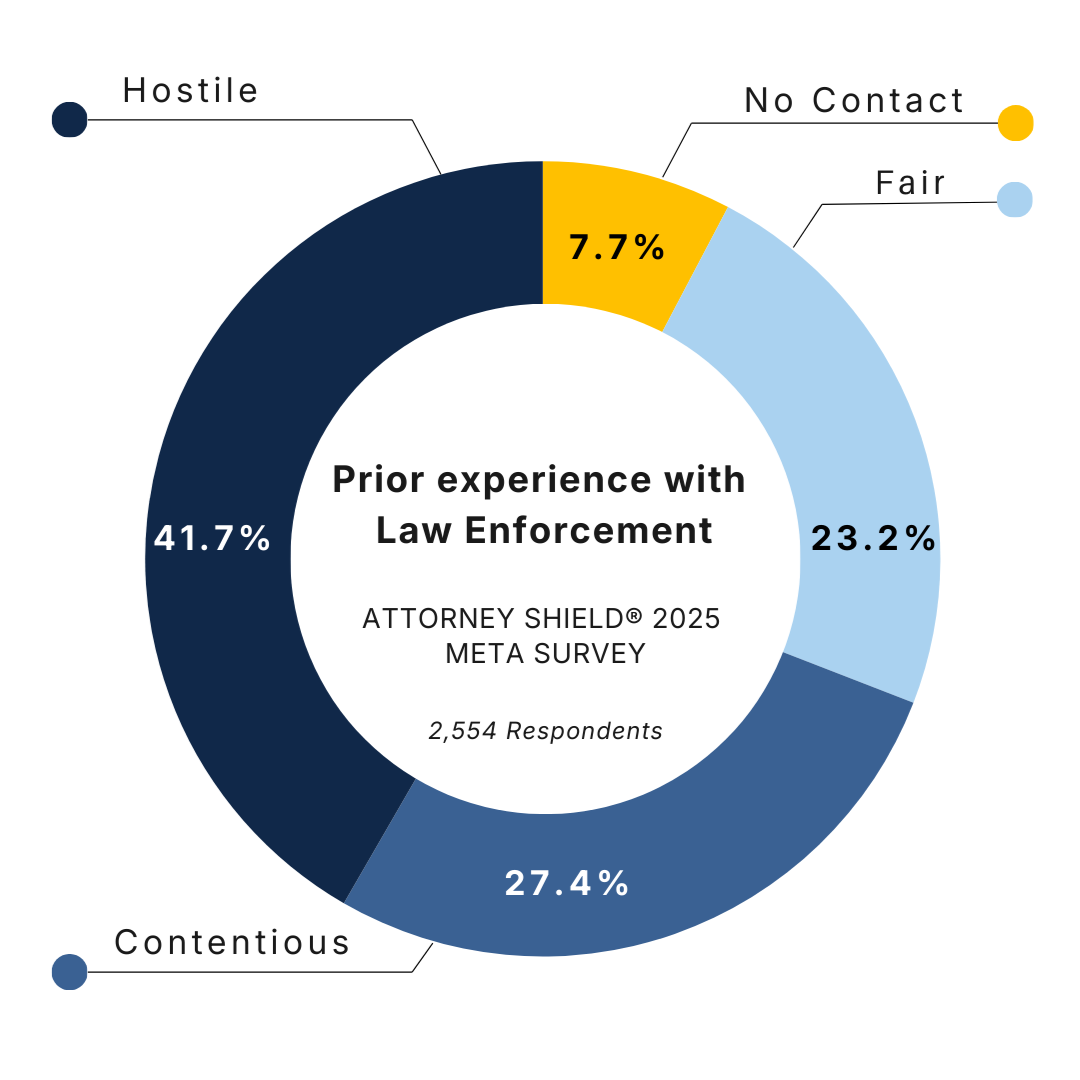
Attorney Shield recently conducted a survey on Meta asking respondents to select the option that best described their prior experience with law enforcement. A total of 2,554 responses were collected, producing the following distribution:
7.7% — Had no interaction
23.2% — Fair
27.4% — Contentious
41.7% — Hostile
Key Observations
The most striking outcome of the survey is that nearly 70% of respondents described their experiences as either “contentious” or “hostile.” This suggests that for a significant portion of respondents, interactions with law enforcement are not merely uncomfortable or inconvenient, but adversarial in nature. By contrast, fewer than one in four respondents described their experience as “fair,” and less than one in ten reported no interaction at all.
The data reflects a sharp departure from the commonly held assumption that negative police encounters are rare or isolated. Instead, the results indicate that negative experiences are not only common, but dominant among this respondent pool.
Understanding the Categories
While the survey allowed respondents to self-select descriptive categories, the progression from “fair” to “contentious” to “hostile” is important. A fair interaction suggests neutrality or professionalism, even if the encounter itself was unwanted. Contentious implies friction, disagreement, or perceived imbalance of power. Hostile suggests fear, intimidation, aggression, or a belief that the officer acted unfairly, abusively, or with unnecessary force.
The fact that “hostile” is the most selected response, outpacing all other categories, signals a deeper issue than routine dissatisfaction. It points to erosion of trust, perceived lack of procedural fairness, and a belief among many respondents that law enforcement encounters place them at personal risk.
A Defensible Explanation for the Results
Several factors may help explain these outcomes in a defensible and evidence-based manner:
Increased Enforcement Over Investigation
Over the past several decades, policing strategies have increasingly prioritized enforcement metrics—stops, citations, arrests—over thorough investigation. This approach naturally increases friction, especially in low-level or discretionary encounters where citizens feel targeted rather than protected.Power Imbalance During Police Encounters
Police interactions are inherently asymmetrical. Officers possess authority, discretion, and often immunity in the moment. For civilians, especially those without legal knowledge, even routine encounters can feel coercive or threatening, particularly when questioning escalates toward self-incrimination.Lack of Transparency and Accountability
When encounters are not recorded, explained, or subject to meaningful review, civilians are more likely to interpret outcomes as arbitrary or hostile. The absence of clear accountability mechanisms contributes directly to negative perceptions—even when no charges result.Cultural and Media Context
Public awareness of police misconduct has increased substantially due to widespread video documentation. This does not necessarily mean misconduct is new, but rather that visibility has increased. Prior knowledge and expectation shape perception, often heightening anxiety during encounters.Self-Selection Bias (Acknowledged but Not Disqualifying)
It is reasonable to acknowledge that respondents engaging with Attorney Shield content may already be more concerned about police encounters than the general population. However, even accounting for this bias, the magnitude of the results, particularly the dominance of “hostile”, remains significant and cannot be dismissed as anecdotal.
Conclusion
This survey highlights a sobering reality: for many Americans, interactions with law enforcement are perceived as adversarial rather than protective. When fewer than one-quarter of respondents describe their experiences as fair, and more than two-fifths describe them as hostile, the data suggests a serious trust gap with meaningful societal implications.
These findings reinforce the importance of tools, education, and legal support that help rebalance power, promote de-escalation, and protect individual rights during police encounters. They also underscore the need for greater transparency, accountability, and procedural justice. ~
← Older Post Newer Post →